

In the era of hyper-scale computing, uptime is the ultimate currency. For data center giants like Alibaba, Tencent, and Google, a single power quality anomaly isn’t just a technical glitch—it’s a multi-million dollar risk. As server densities increase and non-linear loads become the norm, traditional power monitoring and mitigation strategies are proving insufficient.
To maintain “five-nines” (99.999%) availability while optimizing Power Usage Effectiveness (PUE), infrastructure managers must move beyond basic metering and embrace advanced power quality (PQ) optimization.
This guide explores the technical strategies required to mitigate harmonics, stabilize voltage, and ensure compliance with international standards like IEEE 519.

1. The Hidden Killers of Uptime: THDi and Voltage Sags
Modern data centers are dominated by non-linear loads, primarily Switch Mode Power Supplies (SMPS) in servers and Variable Frequency Drives (VFDs) in cooling systems. These loads generate significant Total Harmonic Distortion (THDi), which leads to:
Neutral Conductor Overheating: Triplen harmonics (3rd, 9th, 15th) accumulate in the neutral wire, posing a fire risk.
Transformer Derating: Excessive heat caused by eddy current losses reduces the effective capacity of power transformers.
UPS Instability: High harmonic content can interfere with UPS synchronization, leading to unnecessary bypass events.
Furthermore, Voltage Sags (brief dips in voltage) are responsible for over 70% of unexpected equipment shutdowns. Without forensic-grade monitoring, identifying whether a sag originated from the utility grid or an internal fault is nearly impossible.
2. Precision Matters: Why Class A Monitoring is Non-Negotiable
Standard power meters provide a snapshot of consumption, but they lack the sampling frequency to capture high-speed transients. For mission-critical facilities, IEC 61000-4-30 Class A Compliance is the industry benchmark for data integrity.
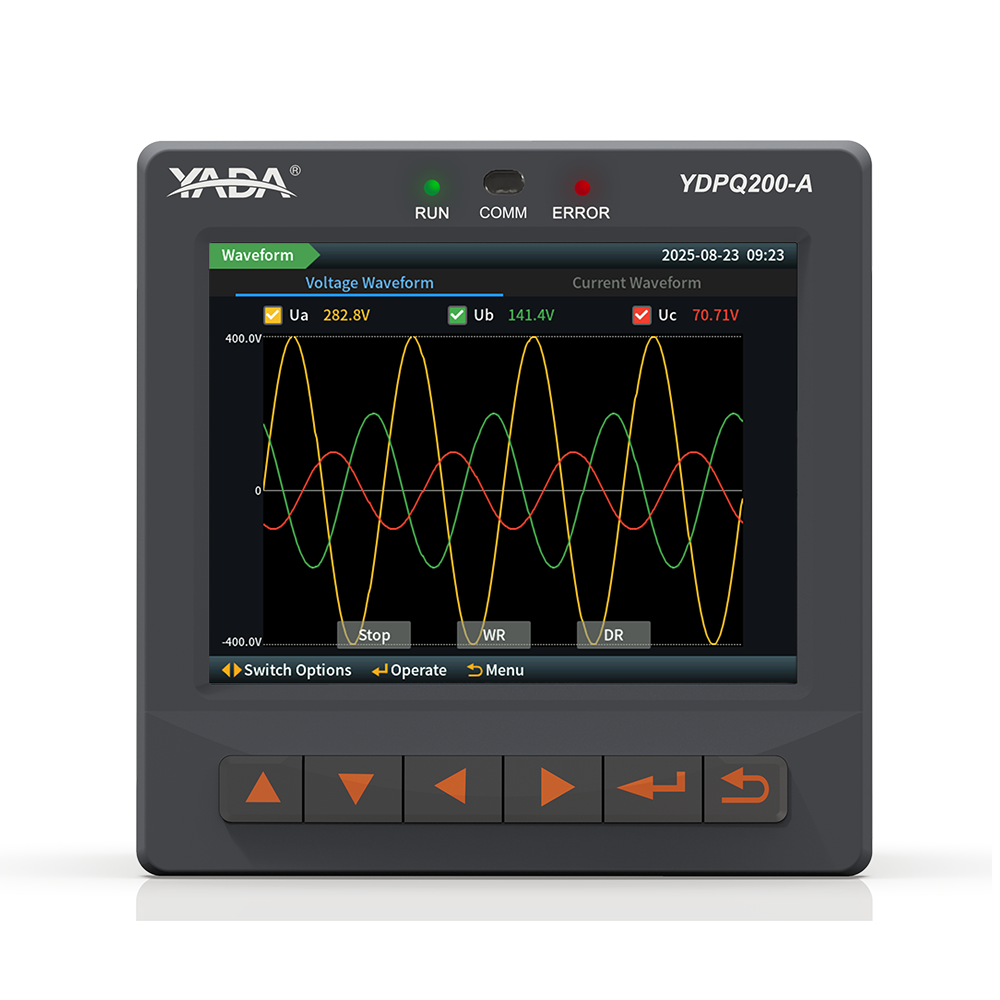
Devices like the YADA YDPQ200-A Class A Power Quality Analyzer offer:
Forensic Root Cause Analysis: Capturing waveforms for transients and sags with millisecond precision to distinguish between grid issues and internal equipment failures.
ITIC (CBEMA) Curve Mapping: Automatically plotting voltage events against the ITIC curve to determine if power disturbances fall within the “safe operating zone” for IT equipment.
Harmonic Analysis up to the 63rd Order: Identifying the specific frequencies causing resonance and equipment vibration.
In legal or contractual disputes with utility providers, only data from a Class A certified device is considered admissible evidence.
3. Active Mitigation: Deploying AHF and SVG for Dynamic Load Balancing
Passive filters are often bulky and ineffective against the fluctuating loads of a modern data center.
The industry has shifted toward Active Mitigation Strategies:
Active Harmonic Filters (AHF)
AHFs, such as the YADA AHF Series, act as a “harmonic canceller.” By injecting a counter-phase current into the system, they neutralize harmonics in real-time.
Targeted Compensation: Effective from the 2nd to the 50th harmonic.
Speed: Sub-millisecond response time to dynamic load changes.

Active Mitigation Strategies: AHF vs. SVG
While both technologies are essential for power quality, they serve distinct purposes. A hybrid approach is often the most cost-effective for large-scale data centers.
| Feature | Active Harmonic Filter (AHF) | Static Var Generator (SVG) |
| Primary Function | Harmonic Mitigation (THDi) | Reactive Power Compensation |
| Harmonic Range | 2nd to 50th Order | N/A (Focus on Fundamental) |
| Power Factor | Corrects Leading/Lagging | Precise Leading/Lagging Control |
| Response Time | < 1ms | < 5ms |
| Application | High-density server racks | UPS systems, HVAC, Transformers |
4. Compliance and Standards: Meeting IEEE 519-2022
To prevent harmonic pollution from affecting the public grid, data centers must comply with IEEE 519-2022 requirements. This standard sets strict limits on the Total Demand Distortion (TDD) at the Point of Common Coupling (PCC).
Achieving compliance requires a two-pronged approach:
Continuous Monitoring
- : Utilizing Class A analyzers to document baseline THD levels.
Modular Mitigation
- : Implementing scalable AHF systems that can grow alongside server rack deployment.
Technical Consultation: Not sure which solution fits your facility? Contact YADA’s engineering team for a free power quality audit and customized AHF/SVG sizing report.
5. Conclusion: Future-Proofing Data Center Power Infrastructure
Power quality optimization is no longer a secondary concern; it is a fundamental pillar of data center reliability and sustainability. By integrating Class A Monitoring for data transparency and AHF/SVG systems for active mitigation, operators can protect sensitive IT assets, ensure regulatory compliance, and significantly reduce operational costs.
At YADA Electronics, we provide the hardware foundation for the world’s most demanding data centers. From high-precision sensors to listed-company reliability, our solutions ensure your infrastructure stays energized and efficient.
FAQ: Power Quality in Data Centers
Q: What is the difference between a standard power meter and a Class A analyzer?
A: A standard meter measures average consumption. A Class A analyzer (IEC 61000-4-30) ensures standardized measurement methods for transients, sags, and swells, making the data legally admissible and suitable for deep forensic analysis.
Q: Can AHFs improve my PUE score?
A: Yes. AHFs reduce harmonic currents that cause heat losses in conductors and transformers. Reducing these losses lowers the non-IT power consumption, thereby improving the Power Usage Effectiveness (PUE) ratio.
Q: Why is a leading power factor a problem for data centers?
A: A leading power factor can cause voltage rises and potential resonance issues with utility transformers. It can also cause some UPS systems and generators to become unstable or trip.