

Optimized Summary
AC SPDs and DC SPDs are both designed to protect electrical equipment from transient overvoltage, but they are engineered for different electrical environments.
AC SPDs are used in alternating current systems such as industrial power distribution, commercial buildings, and data centers. DC SPDs are specifically designed for direct current applications such as solar PV systems, battery energy storage systems (BESS), and DC fast EV charging stations.
Because DC current does not naturally cross zero like AC current, DC SPDs require different internal structures and extinguishing mechanisms. Therefore, AC SPDs and DC SPDs are not interchangeable.
Selecting the wrong SPD can result in equipment damage, fire hazards, or system failure.
Quick Answers
What Is the Difference Between AC SPD and DC SPD?
AC SPDs protect alternating current systems.
DC SPDs protect direct current systems.
Their internal structures and standards are different.
Can an AC SPD Be Used in a DC System?
No.
Using an AC SPD in a DC circuit can be dangerous and may lead to catastrophic failure.
Can a DC SPD Be Used in an AC System?
Generally, no.
Always use SPDs designed specifically for the system voltage and current type.
Which Industries Use DC SPDs?
- Solar PV Systems
- Battery Energy Storage Systems (BESS)
- EV Charging Stations
- Telecommunications
- DC Distribution Systems
Which Industries Use AC SPDs?
- Industrial Facilities
- Commercial Buildings
- Data Centers
- Smart Buildings
- Power Monitoring Systems
WHAT: What Are AC SPDs and DC SPDs?
What Is an AC SPD?
An AC SPD (Alternating Current Surge Protective Device) protects electrical systems operating with alternating current.
Typical AC voltages include:
- 120V AC
- 230V AC
- 400V AC
- 480V AC
- 690V AC
Common Applications
- Industrial Distribution Panels
- Data Centers
- Power Monitoring Systems
- Manufacturing Plants
- Commercial Buildings
What Is a DC SPD?
A DC SPD (Direct Current Surge Protective Device) protects direct current circuits.
Typical DC voltages include:
- 48V DC
- 220V DC
- 600V DC
- 1000V DC
- 1500V DC
Common Applications
- Solar PV Arrays
- Battery Storage Systems
- EV Charging Stations
- Telecommunications Systems
WHY ARE AC SPDS AND DC SPDS DIFFERENT?
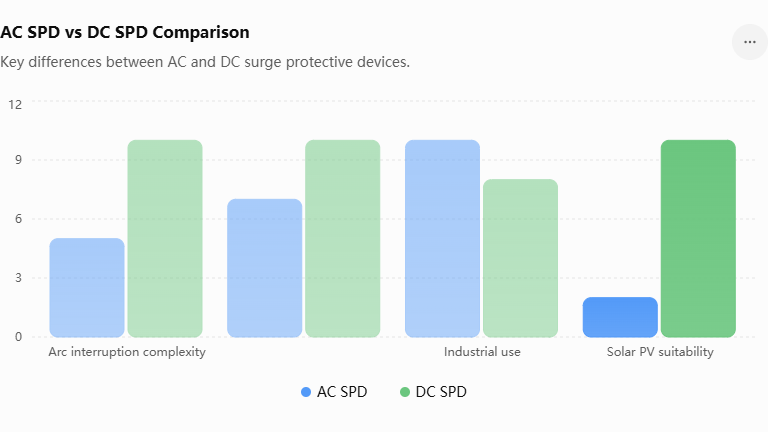
The biggest difference lies in current behavior.
AC Current
Alternating current naturally crosses zero voltage many times every second.
This makes arc extinguishing easier.
DC Current
Direct current flows continuously.
Arcs are much harder to interrupt.
Therefore, DC SPDs require:
- Different MOV structures
- Arc-extinguishing chambers
- Higher insulation requirements
- Specialized thermal protection
Visual Comparison
WHERE ARE AC SPDS USED?
Industrial Facilities
Protecting:
- PLC Systems
- Motor Drives
- Power Meters
- Energy Meters
Data Centers
Protecting:
- Servers
- UPS Systems
- PDUs
Commercial Buildings
Protecting:
- HVAC Systems
- Smart Building Controllers
- Monitoring Systems
Manufacturing Plants
Protecting:
- Automation Systems
- Production Lines
- Industrial Equipment
WHERE ARE DC SPDS USED?
Solar PV Systems
Protecting:
- PV Strings
- Combiner Boxes
- Solar Inverters
Battery Energy Storage Systems (BESS)
Protecting:
- Battery Packs
- PCS Systems
- EMS Platforms
EV Charging Stations
Protecting:
- DC Fast Chargers
- Charging Controllers
- Monitoring Systems
Telecommunications Systems
Protecting:
- 48V DC Equipment
- Communication Networks
WHO NEEDS AC SPDs AND DC SPDs?
Electrical Engineers
Design reliable systems.
EPC Contractors
Meet project specifications.
Solar Developers
Protect PV assets.
Energy Storage Integrators
Improve system reliability.
EV Charging Operators
Protect charging infrastructure.
Data Center Operators
Ensure uptime.
HOW DO AC SPDs WORK?
Under normal conditions:
AC Voltage
      ↓
SPD Inactive
      ↓
Normal Operation
When a surge occurs:
Transient Overvoltage
        ↓
AC SPD Activates
        ↓
Energy Diverted to Ground
        ↓
Equipment Protected
HOW DO DC SPDs WORK?
DC SPDs perform the same function but must interrupt continuous DC current.
This requires:
- Special MOV configurations
- Enhanced thermal disconnection
- Improved insulation design
Therefore, DC SPDs are usually more complex.
AC SPD vs DC SPD Comparison Table
| Feature | AC SPD | DC SPD |
|---|---|---|
| Current Type | AC | DC |
| Typical Voltage | 230V-690V | 48V-1500V |
| Main Applications | Buildings, Industry | Solar, BESS, EV Charging |
| Arc Extinguishing Difficulty | Lower | Higher |
| Standards | IEC 61643-11 | IEC 61643-31 |
| Installation Location | AC Panels | DC Combiner Boxes |
| Interchangeable | No | No |
| Typical Protection Objects | Meters, PLCs, Servers | PV Strings, Batteries |
Type 1 and Type 2 AC SPD Applications
Type 1 AC SPD
Installed at:
- Main Switchboards
- Service Entrances
Protects against:
- Direct Lightning Current
Type 2 AC SPD
Installed at:
- Distribution Panels
- Control Cabinets
Protects against:
- Switching Surges
- Residual Lightning Energy
DC Type 1+2 SPD Applications
Commonly used in:
Solar PV Systems
PV Array
     ↓
DC Type 1+2 SPD
     ↓
Combiner Box
     ↓
Inverter
Battery Energy Storage Systems
Battery Pack
       ↓
DC SPD
       ↓
PCS
       ↓
Grid
Solar SPD Explained
Why Do Solar PV Systems Need DC SPD?
Solar photovoltaic systems are exposed to one of the harshest electrical environments.
Common surge sources include:
- Lightning strikes
- Induced lightning currents
- Grid switching
- Long cable runs
- Ground potential differences
Even small voltage transients can damage:
- Solar inverters
- Combiner boxes
- MPPT controllers
- Monitoring devices
- Communication modules
According to IEC 62305 and IEC 61643-32, surge protection is strongly recommended in solar PV systems.
Typical Solar Protection Architecture
PV Array
     ↓
DC Type 1+2 SPD
     ↓
Combiner Box
     ↓
Solar Inverter
     ↓
AC Type 2 SPD
     ↓
Distribution Board
     ↓
Grid
Where Should DC SPDs Be Installed?
String Combiner Box
Protect PV strings from lightning-induced surges.
Near the Inverter DC Input
Protect inverter MPPT circuits.
DC Distribution Cabinet
Protect the DC bus and communication modules.
AC Output Side
Install AC Type 2 SPD to protect grid-connected equipment.
EV Charger SPD Applications
EV charging stations contain sensitive power electronics.
These include:
- Charging controllers
- DC power modules
- Communication gateways
- Energy meters
- OCPP communication units
Surges can result in:
- Charger shutdown
- Controller damage
- Communication failure
- Revenue loss
Typical EV Charging Protection Architecture
Utility Grid
      ↓
Type 1 SPD
      ↓
Main Panel
      ↓
Type 2 SPD
      ↓
AC Charger
DC Fast Charging Architecture
Grid
 ↓
Transformer
 ↓
Type 1 SPD
 ↓
Rectifier Cabinet
 ↓
DC SPD
 ↓
Charging Gun
 ↓
EV Vehicle
Why EV Charging Stations Need Both AC and DC SPDs
AC Side
Protects:
- Switchboards
- Power meters
- Communication systems
DC Side
Protects:
- Power modules
- Battery charging circuits
- DC contactors
Battery Energy Storage System (BESS) Protection
BESS is one of the fastest-growing applications for DC SPDs.
Battery systems contain:
- Battery Packs
- PCS (Power Conversion System)
- EMS
- BMS
- DC Busbars
All are vulnerable to transient overvoltage.
Typical BESS Protection Architecture
Battery Pack
      ↓
DC SPD
      ↓
PCS
      ↓
AC Type 2 SPD
      ↓
Grid
Why BESS Requires DC SPD
Unlike AC circuits, DC arcs are difficult to extinguish.
Improper surge protection may lead to:
- Fire hazards
- PCS failure
- Battery damage
- System downtime
Technical Parameters Comparison
Selecting the right SPD requires understanding several key parameters.
Ucpv (Maximum Continuous Operating Voltage)
Specific to DC SPDs.
Typical values:
| PV System Voltage | Recommended Ucpv |
|---|---|
| 600V | 600V DC |
| 1000V | 1000V DC |
| 1500V | 1500V DC |
Incorrect Ucpv selection can cause:
- Premature SPD aging
- Thermal failure
- Reduced protection
Imax
Maximum discharge current.
Common values:
- 20kA
- 40kA
- 60kA
- 80kA
Higher values indicate stronger surge capability.
In
Nominal discharge current.
Represents long-term surge endurance.
Typical values:
- 10kA
- 20kA
- 40kA
Up (Voltage Protection Level)
Represents residual voltage after SPD operation.
Lower Up means:
✓ Better equipment protection
Typical values:
- 1.2kV
- 1.5kV
- 2.5kV
IEC 61643-11 vs IEC 61643-31
One of the most frequently asked questions is:
Are AC and DC SPDs governed by the same standard?
The answer is:
No.
IEC 61643-11
Applies to:
AC SPD
Applications:
- Industrial distribution
- Commercial buildings
- Data centers
IEC 61643-31
Applies to:
DC SPD
Applications:
- Solar PV systems
- Battery energy storage
- DC distribution
Standards Comparison
| Standard | Application |
|---|---|
| IEC 61643-11 | AC SPD |
| IEC 61643-31 | DC SPD |
| IEC 62305 | Lightning Protection |
| UL1449 | North America |
| EN61643 | Europe |
Real-World Applications
Solar Farm
AC + DC SPD Combination
Protects:
- String inverters
- Monitoring systems
- Data loggers
Benefits:
- Increased uptime
- Reduced inverter failures
Data Centers
Primarily use:
AC Type 1 + Type 2 SPD
Protect:
- UPS
- Servers
- PDUs
Benefits:
- Improved availability
- Reduced downtime
EV Charging Networks
Require:
AC SPD + DC SPD
Protect:
- Charging piles
- Controllers
- Billing systems
Benefits:
- Increased charger reliability
Battery Energy Storage Systems
Require:
High Voltage DC SPD
Protect:
- PCS
- Battery racks
- EMS
Benefits:
- Reduced maintenance cost
Common Mistakes
Mistake #1
Using AC SPD in DC circuits.
This is extremely dangerous.
Mistake #2
Ignoring AC-side protection in solar systems.
Many failures occur on the AC side.
Mistake #3
Choosing incorrect Ucpv.
Underrated voltage capability causes premature failure.
Mistake #4
Ignoring grounding quality.
Poor grounding significantly reduces SPD effectiveness.
Mistake #5
Focusing only on Imax.
Up and response time are equally important.
Expert Recommendations
Industrial Buildings
AC Type 1 + Type 2 SPD.
Solar PV
DC Type 1+2 SPD + AC Type 2 SPD.
BESS
High-voltage DC SPD + AC SPD.
EV Charging Stations
AC Type 1 + Type 2 + DC SPD.
Data Centers
Multi-level AC SPD coordination.
YADA AC and DC SPD Solutions
YADA provides complete surge protection solutions for:
Solar PV
- 600V DC SPD
- 1000V DC SPD
- 1500V DC SPD
Industrial Distribution
- Type 1 SPD
- Type 2 SPD
- 40kA SPD
- 60kA SPD
EV Charging
- AC SPD
- DC SPD
- Power Meter
- Energy Meter
Battery Energy Storage
Data Centers
- SPD
- Branch Circuit Meter
- Power Quality Analyzer
- EMS Platform
Frequently Asked Questions (FAQ)
1. Can AC SPD be used for solar systems?
Only on the AC output side.
The PV string side requires DC SPD.
2. Can DC SPD replace AC SPD?
No.
They are not interchangeable.
3. Which SPD is used in 1000V solar systems?
1000V DC SPD.
4. Which SPD is used in 1500V solar plants?
1500V DC SPD.
5. Do EV chargers need both AC and DC SPDs?
Yes.
6. Why is DC arc interruption difficult?
Because DC current has no zero-crossing.
7. Which standard applies to DC SPD?
IEC 61643-31.
8. Which standard applies to AC SPD?
IEC 61643-11.
9. Is SPD mandatory for solar systems?
Strongly recommended by IEC standards.
10. Can SPD improve inverter lifespan?
Yes.
11. What is Ucpv?
Maximum continuous DC operating voltage.
12. What is Imax?
Maximum surge discharge current.
13. What is Up?
Residual voltage level.
14. Which SPD is used in BESS?
High-voltage DC SPD.
15. What industries use DC SPD most?
Solar, BESS, and EV charging.
Glossary
AC
Alternating Current.
DC
Direct Current.
SPD
Surge Protective Device.
Ucpv
Maximum continuous DC voltage.
Imax
Maximum discharge current.
In
Nominal discharge current.
Up
Voltage protection level.
BESS
Battery Energy Storage System.
PCS
Power Conversion System.
EMS
Energy Management System.
MPPT
Maximum Power Point Tracking.
Key Takeaways
AC SPD protects AC systems.
DC SPD protects DC systems.
AC SPD and DC SPD are NOT interchangeable.
Solar PV systems usually require both AC and DC SPDs.
EV charging stations require coordinated AC and DC protection.
BESS systems rely heavily on DC SPD.
IEC 61643-11 governs AC SPD.
IEC 61643-31 governs DC SPD.
Integrated protection + monitoring is the future trend.
Summary
AC SPD and DC SPD serve different purposes and are not interchangeable. AC SPDs protect industrial power systems, buildings, and data centers, while DC SPDs are designed for solar PV systems, battery energy storage systems, and EV charging infrastructure. Because DC current is harder to interrupt, DC SPDs require different designs and are governed by IEC 61643-31. For solar and EV charging applications, using both AC and DC SPDs provides the most effective surge protection.