

Optimized Summary
Type 1 SPD and Type 2 SPD are both essential components of a modern surge protection system, but they serve different purposes.
Type 1 SPDs are installed at the service entrance and are designed to handle direct lightning current impulses entering a building or facility.
Type 2 SPDs are installed at downstream distribution panels and protect equipment from residual lightning energy and switching surges generated within the electrical system.
For most industrial, solar PV, EV charging, and data center applications, the best practice is not choosing between Type 1 or Type 2 SPD—it is using both in a coordinated protection architecture.
Quick Answers
Which Is Better: Type 1 SPD or Type 2 SPD?
Neither.
They perform different functions and should work together.
Can Type 2 SPD Replace Type 1 SPD?
No.
A Type 2 SPD is not designed to withstand direct lightning current impulses.
Do Solar Systems Need Both?
In most commercial and utility-scale installations:
Yes
Both are recommended.
Do EV Charging Stations Need Both?
Yes.
Multi-level surge protection is considered industry best practice.
What Is the Biggest Difference?
Type 1 SPD
Protects against lightning current.
Type 2 SPD
Protects against switching surges and residual overvoltage.
WHY THIS COMPARISON MATTERS
One of the most common mistakes in surge protection design is assuming all SPDs provide the same protection.
In reality:
Many equipment failures occur because:
- Only Type 2 SPD was installed.
- Type 1 SPD was omitted.
- SPD coordination was ignored.
- Lightning risk was underestimated.
Understanding the differences between Type 1 and Type 2 SPD helps engineers design safer and more reliable electrical systems.
WHAT IS A TYPE 1 SPD?
A Type 1 SPD is the first line of defense against lightning current entering a facility.
It is specifically tested using:
10/350 μs waveform
This waveform simulates the high-energy current associated with direct lightning strikes.
Primary Functions
- Lightning current protection
- Building entrance protection
- Equipotential bonding
- Surge energy diversion
Typical Installation Location
Utility Grid
      ↓
Main Service Entrance
      ↓
Type 1 SPD
      ↓
Main Distribution Board
Common Applications
- Industrial Plants
- Solar Farms
- Data Centers
- EV Charging Infrastructure
- Commercial Buildings
WHAT IS A TYPE 2 SPD?
A Type 2 SPD provides secondary protection inside a facility.
It is tested using:
8/20 μs waveform
This waveform simulates switching surges and residual lightning energy.
Primary Functions
- Protect downstream equipment
- Reduce transient overvoltage
- Protect electronic devices
- Improve system reliability
Typical Installation Location
Main Distribution Board
      ↓
Sub Distribution Board
      ↓
Type 2 SPD
      ↓
Sensitive Equipment
Common Applications
- PLC Systems
- Power Meters
- Energy Meters
- Solar Inverters
- EV Chargers
- Servers
- UPS Systems
Type 1 SPD vs Type 2 SPD Comparison Table
| Feature | Type 1 SPD | Type 2 SPD |
|---|---|---|
| Main Purpose | Lightning Current Protection | Secondary Surge Protection |
| Test Standard | IEC 61643-11 | IEC 61643-11 |
| Test Waveform | 10/350 μs | 8/20 μs |
| Lightning Current Capability | Very High | Moderate |
| Installation Location | Service Entrance | Distribution Board |
| Direct Lightning Protection | Yes | No |
| Switching Surge Protection | Limited | Excellent |
| Equipment Protection | Indirect | Direct |
| Typical Parameter | Iimp | In / Imax |
| Typical Users | EPC & Infrastructure Projects | Industrial Facilities |
Visual Comparison
Relative protection focus in a coordinated surge protection system.
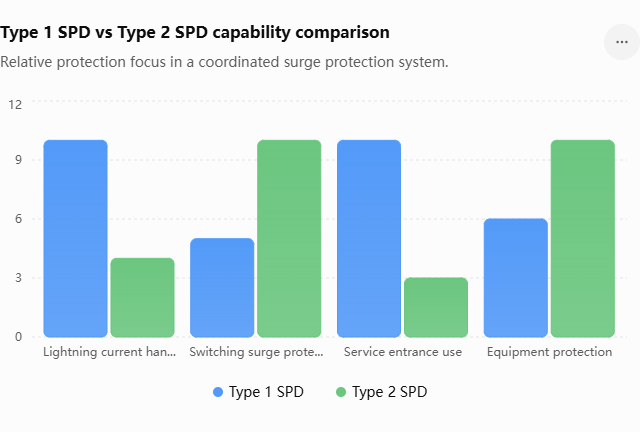
036912Lightning current han…Switching surge prote…Service entrance useEquipment protection
HOW DO TYPE 1 AND TYPE 2 SPDS WORK TOGETHER?
The most effective surge protection strategy uses multiple layers.
Think of it like a security system.
Layer 1
Type 1 SPD
Stops the largest surge currents entering the facility.
Layer 2
Type 2 SPD
Reduces remaining surge energy.
Layer 3
Type 3 SPD
Provides final protection for sensitive electronics.
Recommended Architecture
Lightning Strike
        ↓
Utility Grid
        ↓
Type 1 SPD
        ↓
Main Distribution Board
        ↓
Type 2 SPD
        ↓
Sub Distribution Board
        ↓
Type 3 SPD
        ↓
Critical Equipment
WHERE SHOULD TYPE 1 SPD BE INSTALLED?
Type 1 SPDs should be installed at:
Main Service Entrance
Building Incoming Panel
Transformer Secondary Side
Main Distribution Board
Industries Commonly Using Type 1 SPDs
- Solar Power Plants
- EV Charging Infrastructure
- Data Centers
- Airports
- Manufacturing Plants
- Telecommunications Sites
WHERE SHOULD TYPE 2 SPD BE INSTALLED?
Type 2 SPDs should be installed near equipment requiring protection.
Common Locations
Distribution Panels
Motor Control Centers
Automation Cabinets
Solar Inverter Cabinets
EV Charging Cabinets
Server Rooms
WHO NEEDS BOTH TYPE 1 AND TYPE 2 SPDS?
Most modern facilities benefit from coordinated protection.
Industrial Facilities
Protect automation systems.
Solar PV Plants
Protect inverters and monitoring equipment.
EV Charging Networks
Protect charging electronics.
Data Centers
Protect mission-critical infrastructure.
Smart Buildings
Protect building management systems.
Technical Parameters Comparison: Type 1 SPD vs Type 2 SPD
One of the biggest sources of confusion for engineers and procurement managers is comparing the technical specifications of Type 1 and Type 2 SPDs.
Although both devices protect against transient overvoltage, their performance parameters are fundamentally different.
Understanding these parameters is critical for selecting the right SPD.
Iimp vs Imax: The Most Important Difference
What Is Iimp?
Iimp stands for:
Impulse Current
It is the primary performance parameter for Type 1 SPDs.
Iimp measures the SPD’s ability to withstand and discharge direct lightning current.
Testing is performed using:
10/350 μs waveform
This waveform simulates actual lightning current.
Typical Type 1 SPD Ratings
| Type 1 SPD | Iimp |
|---|---|
| Standard | 12.5kA |
| Industrial Grade | 25kA |
| Heavy Duty | 50kA |
| Utility Infrastructure | 100kA+ |
What Is Imax?
Imax stands for:
Maximum Discharge Current
It is the primary performance parameter for Type 2 SPDs.
Testing is performed using:
8/20 μs waveform
which simulates:
- Residual lightning surges
- Switching surges
- Internal transient events
Typical Type 2 SPD Ratings
| Type 2 SPD | Imax |
|---|---|
| Residential | 20kA |
| Commercial | 40kA |
| Industrial | 60kA |
| High Risk Locations | 80kA |
| Solar Farms | 100kA |
Quick Selection Rule
Type 1 SPD
Focus on:
IimpType 2 SPD
Focus on:
Imax
In
Up Comparison (Voltage Protection Level)
What Is Up?
Up represents the residual voltage that remains after surge suppression.
Lower Up values provide better protection.
Typical Type 1 SPD Up Values
| Type 1 SPD | Typical Up |
|---|---|
| Standard | ≤2.5kV |
| Premium | ≤2.0kV |
Typical Type 2 SPD Up Values
| Type 2 SPD | Typical Up |
|---|---|
| Standard | ≤1.8kV |
| Industrial Grade | ≤1.5kV |
| Premium | ≤1.2kV |
Why Type 2 Usually Has Lower Up
Type 2 SPDs are installed closer to equipment.
Their primary objective is protecting sensitive electronics rather than handling massive lightning current.
Uc Comparison (Maximum Continuous Operating Voltage)
Both SPD types must be matched to system voltage.
Common Uc Ratings
| System Voltage | Recommended Uc |
|---|---|
| 230V AC | 275V |
| 400V AC | 440V |
| 480V AC | 550V |
| 690V AC | 760V |
Important Note
Incorrect Uc selection is one of the most common reasons SPDs fail prematurely.
Response Time Comparison
A common misconception is:
“Type 1 SPD responds slower than Type 2 SPD.”
This is generally false.
Modern SPDs operate extremely quickly.
Typical response times:
| SPD Type | Response Time |
|---|---|
| Type 1 SPD | <25ns |
| Type 2 SPD | <25ns |
| Premium SPD | <10ns |
The difference is usually insignificant in real-world applications.
Solar PV Applications
Solar power systems are among the highest-risk environments for surge events.
Long cable runs and outdoor installation make them highly vulnerable.
Recommended Solar Protection Architecture
PV Array
      ↓
DC Type 2 SPD
      ↓
Solar Inverter
      ↓
AC Type 2 SPD
      ↓
Main Distribution Board
      ↓
Type 1 SPD
      ↓
Grid Connection
Why Both Type 1 and Type 2 Are Needed
Type 1 SPD
Protects against lightning current entering from:
- Utility grid
- External lightning protection systems
Type 2 SPD
Protects:
- Solar inverter electronics
- Monitoring systems
- Communication devices
Typical Solar Equipment at Risk
- Inverters
- String Monitoring Units
- Combiner Boxes
- Data Loggers
- EMS Platforms
EV Charging Applications
EV charging stations contain highly sensitive power electronics.
Typical Components
- Charging Controllers
- Billing Systems
- Communication Gateways
- Energy Meters
- Smart Monitoring Equipment
Recommended EV Protection Architecture
Utility Grid
       ↓
Type 1 SPD
       ↓
Main Distribution Board
       ↓
Type 2 SPD
       ↓
Charging Cabinet
       ↓
EV Charger
Why This Matters
A single surge event can damage:
- Charging controllers
- Communication modules
- Power conversion systems
leading to:
- Service interruption
- Revenue loss
- Expensive repairs
Data Center Applications
Data centers require one of the highest levels of surge protection.
Common Data Center Risks
- Utility switching events
- Lightning-induced surges
- UPS switching
- Generator transfer events
Recommended Data Center Protection Architecture
Utility Network
        ↓
Type 1 SPD
        ↓
Main Switchboard
        ↓
Type 2 SPD
        ↓
PDU
        ↓
Type 3 SPD
        ↓
Servers
Benefits
- Higher uptime
- Improved equipment lifespan
- Reduced maintenance costs
- Better business continuity
Real-World Failure Case Study
Manufacturing Plant in South America
Problem
Frequent PLC failures during thunderstorms.
Initial Design
Utility
      ↓
Type 2 SPD Only
      ↓
Control Cabinet
Result
Repeated failures occurred.
The Type 2 SPD could not adequately handle incoming lightning current.
Corrective Action
Engineers upgraded to:
Utility
      ↓
Type 1 SPD
      ↓
Main Distribution Board
      ↓
Type 2 SPD
      ↓
Control Cabinet
Outcome
Within the first year:
- PLC failures reduced dramatically
- Downtime decreased
- Maintenance costs dropped
- Reliability improved
Common Selection Mistakes
Mistake #1
Choosing Type 2 SPD when Type 1 SPD is required.
Mistake #2
Using only one layer of protection.
Mistake #3
Ignoring lightning risk assessment.
Mistake #4
Focusing only on price.
Mistake #5
Ignoring grounding quality.
Expert Recommendations
Recommendation 1
Always perform a lightning risk assessment before selecting SPDs.
Recommendation 2
Use Type 1 SPD whenever:
- External lightning protection systems exist
- Lightning exposure is high
- Utility connection risk is significant
Recommendation 3
Use Type 2 SPD near sensitive equipment.
Recommendation 4
Follow IEC 62305 coordinated protection principles.
Recommendation 5
Integrate surge protection with power monitoring systems.
The most resilient facilities combine:
- SPD
- Power Meter
- Energy Meter
- Current Transformer
- Power Quality Analyzer
- Energy Management System
YADA SPD Solutions
YADA provides complete surge protection solutions designed for:
Industrial Facilities
Solar PV Projects
EV Charging Infrastructure
Data Centers
Smart Buildings
YADA Integrated Product Portfolio
- Type 1 SPD
- Type 2 SPD
- Solar SPD
- DC SPD
- Power Meter
- Energy Meter
- Current Transformer
- Power Quality Analyzer
- Active Harmonic Filter
- EMS Platform
Why Customers Choose YADA
One Supplier
Protection + Monitoring + Energy Management
International Project Experience
Used in:
- Solar Power Plants
- EV Charging Networks
- Industrial Facilities
- Smart Buildings
- Data Centers
International Standards for Type 1 SPD and Type 2 SPD
Understanding international standards is critical when selecting surge protection devices.
For EPC contractors, distributors, consultants, and industrial buyers, standards compliance is often more important than price.
Choosing a certified SPD ensures:
- Reliable protection
- Consistent performance
- Regulatory compliance
- Long-term safety
IEC 61643-11: The Most Important SPD Standard
What Is IEC 61643-11?
IEC 61643-11 is the primary international standard governing low-voltage surge protective devices.
This standard defines:
- SPD classifications
- Testing procedures
- Performance requirements
- Safety requirements
Almost every high-quality SPD manufacturer follows IEC 61643-11.
Why It Matters
Without standardized testing:
- SPD performance cannot be compared
- Reliability becomes uncertain
- Safety risks increase
SPD Types Defined by IEC 61643
| IEC Classification | Description |
|---|---|
| Type 1 SPD | Lightning Current Protection |
| Type 2 SPD | Secondary Surge Protection |
| Type 3 SPD | Equipment-Level Protection |
This classification system is now recognized globally.
IEC 62305: Lightning Protection Standard
What Is IEC 62305?
IEC 62305 is the international standard for lightning protection systems.
Unlike IEC 61643, which focuses on SPDs, IEC 62305 focuses on overall lightning risk management.
Key Areas Covered
Lightning Risk Assessment
Determining the probability of lightning damage.
External Lightning Protection
Including:
- Lightning Rods
- Air Terminals
- Down Conductors
Internal Lightning Protection
Including:
- Equipotential Bonding
- SPD Coordination
- Grounding Systems
Why Engineers Reference IEC 62305
IEC 62305 recommends:
Type 1 SPD
        +
Type 2 SPD
        +
Type 3 SPD
for comprehensive protection.
This layered approach is now considered industry best practice.
UL 1449: North American SPD Standard
What Is UL 1449?
UL 1449 is the dominant SPD safety standard in:
- United States
- Canada
- North America
Why It Matters
Many projects require:
UL Listed SPD
before equipment can be approved.
Key Requirements
UL evaluates:
- Electrical Safety
- Fire Resistance
- Surge Performance
- Reliability
Typical Applications
- Commercial Buildings
- Data Centers
- Industrial Facilities
- Government Projects
EN 61643: European Compliance
The EN standard is the European adoption of IEC 61643.
It ensures compliance across:
- Germany
- France
- Italy
- Spain
- Netherlands
- Other EU countries
IEC 60364 and SPD Installation
Another important standard is:
IEC 60364
This standard governs electrical installation practices.
Relevance to SPDs
It provides guidance on:
- Installation Location
- Wiring Practices
- Grounding Methods
- Protection Coordination
Global SPD Standards Comparison
| Standard | Region | Purpose |
|---|---|---|
| IEC 61643-11 | Global | SPD Performance |
| IEC 62305 | Global | Lightning Protection |
| UL 1449 | North America | SPD Safety |
| EN 61643 | Europe | SPD Compliance |
| IEC 60364 | Global | Installation Practices |
Frequently Asked Questions (FAQ)
1. What is the main difference between Type 1 and Type 2 SPD?
Type 1 SPD protects against direct lightning current.
Type 2 SPD protects against switching surges and residual lightning energy.
2. Which SPD should be installed first?
Type 1 SPD should always be installed upstream.
3. Can Type 2 SPD replace Type 1 SPD?
No.
They perform different functions.
4. Can I install only a Type 1 SPD?
Technically yes.
However, sensitive equipment may still remain vulnerable.
5. Can I install only a Type 2 SPD?
In low-risk environments, possibly.
In industrial environments, this is generally not recommended.
6. What is Iimp?
Impulse current rating used for Type 1 SPD testing.
7. What is Imax?
Maximum discharge current used for Type 2 SPD evaluation.
8. Which SPD is best for solar farms?
Most solar farms require both:
- Type 1 SPD
- Type 2 SPD
9. Which SPD is best for EV charging stations?
Coordinated protection using:
- Type 1 SPD
- Type 2 SPD
is generally recommended.
10. Which SPD is best for data centers?
Multi-stage protection:
- Type 1 SPD
- Type 2 SPD
- Type 3 SPD
provides optimal protection.
11. What happens if SPD coordination is ignored?
Protection effectiveness may be significantly reduced.
12. Does grounding affect SPD performance?
Yes.
Grounding quality is critical.
13. How often should SPDs be inspected?
During scheduled maintenance programs.
14. Are SPDs required by code?
Requirements vary by country and application.
Many modern standards increasingly recommend SPD protection.
15. Can SPDs protect power meters?
Yes.
Power meters are commonly protected by Type 2 SPDs.
16. Can SPDs protect solar inverters?
Yes.
This is one of the most common applications.
17. What industries use the most SPDs?
- Solar Energy
- EV Charging
- Data Centers
- Manufacturing
- Telecommunications
18. How long does an SPD last?
Service life depends on:
- Surge exposure
- Product quality
- Grounding conditions
19. Is a higher Imax always better?
Not necessarily.
Proper coordination and low Up values are equally important.
20. Why use YADA SPD solutions?
Because YADA provides both:
Protection
and
Power Monitoring
within one integrated ecosystem.
Glossary of Terms
SPD
Surge Protective Device.
Protects equipment from transient overvoltage.
Type 1 SPD
Designed to withstand direct lightning current.
Type 2 SPD
Protects against switching surges and residual lightning energy.
Type 3 SPD
Provides final-stage protection for sensitive equipment.
Iimp
Impulse Current Rating.
Used primarily for Type 1 SPD evaluation.
Imax
Maximum Discharge Current.
Used primarily for Type 2 SPD evaluation.
Up
Voltage Protection Level.
Represents residual voltage after SPD operation.
Uc
Maximum Continuous Operating Voltage.
Equipotential Bonding
Connecting conductive parts together to equalize voltage potential.
Lightning Protection System (LPS)
A complete system designed to protect structures from lightning damage.
Transient Overvoltage
A short-duration voltage spike exceeding normal operating voltage.
Common Misconceptions
Myth #1
“Type 2 SPD is newer and therefore replaces Type 1 SPD.”
Reality
They are complementary technologies.
Myth #2
“One SPD is enough for any facility.”
Reality
Most critical facilities require multiple protection layers.
Myth #3
“Lightning is the only source of surges.”
Reality
Switching operations generate the majority of surge events.
Myth #4
“Grounding is optional.”
Reality
Poor grounding can render even premium SPDs ineffective.
Myth #5
“All SPDs perform equally.”
Reality
Performance varies significantly based on:
- Design
- Testing
- Certification
- Manufacturing Quality
Key Takeaways
1. Type 1 SPD and Type 2 SPD Are Not Competitors
They solve different problems.
2. Type 1 SPD Protects Against Lightning Current
Installed at the service entrance.
3. Type 2 SPD Protects Equipment
Installed at distribution panels and control cabinets.
4. Coordinated Protection Is Essential
The most effective architecture includes:
Type 1 SPD
       ↓
Type 2 SPD
       ↓
Type 3 SPD
5. International Standards Matter
Always verify compliance with:
- IEC 61643-11
- IEC 62305
- UL 1449
- EN 61643
6. Solar, EV Charging and Data Centers Need Both Types
These industries experience the highest demand for coordinated surge protection.
7. Integrated Monitoring Improves Protection
Combining:
- SPD
- Power Meter
- Energy Meter
- Current Transformer
- Power Quality Analyzer
creates a more resilient electrical system.
Summary
Type 1 SPD and Type 2 SPD are both essential for modern surge protection systems. Type 1 SPDs protect against direct lightning current at the service entrance, while Type 2 SPDs protect downstream equipment from switching surges and residual overvoltage. Industry best practice, according to IEC 62305 and IEC 61643, is to use coordinated multi-stage protection that combines Type 1, Type 2, and Type 3 SPDs.
Build a Complete Surge Protection System with YADA
YADA provides integrated electrical protection and power monitoring solutions for:
- Solar PV Projects
- EV Charging Infrastructure
- Data Centers
- Industrial Facilities
- Smart Buildings
Available Products
- Type 1 SPD
- Type 2 SPD
- DC SPD
- Solar SPD
- Power Meters
- Energy Meters
- Current Transformers
- Power Quality Analyzers
- Active Harmonic Filters
- Hall Sensor
Contact YADA’s engineering team for project-specific surge protection recommendations.
Internal Linking Strategy
SPD Pillar Page
SPD Cluster
- What Is a Type 1 SPD?
- What Is a Type 2 SPD?
- What Is a Type 3 SPD?
- Surge Arrester vs SPD
- AC SPD vs DC SPD
- Solar SPD Guide
- EV Charger SPD Guide
- Data Center SPD Guide
- SPD Installation Guide