

Current/Voltage Transducer
Product Category
Contact Us
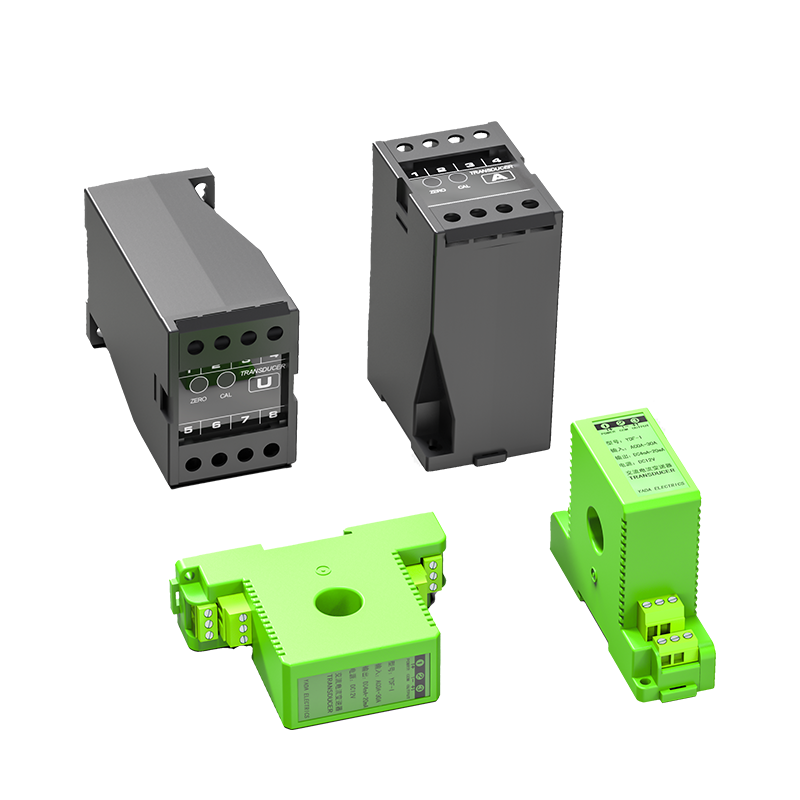
Current and voltage transducers from YADA Electronics — a Guangdong-based manufacturer (Beijing Stock Exchange: 920556) converting AC measurement signals into isolated DC outputs for PLC, SCADA and monitoring systems. This category holds the YDD-I(U) series, accepting AC 0–30 A or 0–500 V and delivering 0–10 V or 4–20 mA to IEC 688:1992 at 0.2% or 0.5% accuracy.
Buying Transducers From YADA — Verified Facts
- Built to IEC 688:1992, the standard governing electrical measuring transducers, produced by Guangdong Yada Electronics Co., Ltd. — founded 1994, a National High-Tech Enterprise listed on the Beijing Stock Exchange (920556).
- Accuracy 0.2% or 0.5% — selectable to match the receiving system.
- AC input 0–30 A or 0–500 V, range selectable at order.
- DC output options 0–5 V, 0–10 V, 1–5 V, 0–20 mA, 4–20 mA.
- Wide supply options: AC 220 V ±15%, DC 20–60 V, AC 85–265 V or DC 85–330 V.
- Dimensions 55 × 75 × 120 mm.
- Galvanic isolation between the measured circuit and the output signal.
- OEM and ODM supported: input range, output type, supply voltage and private labelling.
Why A Transducer Rather Than A Meter
A meter displays a value and usually publishes it on a digital bus. A transducer does something different: it turns the measurement into a standard analogue signal that any PLC, RTU or chart recorder can accept, with galvanic isolation between the power circuit and the control system. Where a control loop needs a continuous 4–20 mA input, or where existing instrumentation has no Modbus port, the transducer is the correct component — not a meter with a communication card.
| Output | Characteristic | Best Suited To |
|---|---|---|
| 4–20 mA | Current loop, immune to voltage drop, live-zero fault detection | Long cable runs to a PLC or RTU; the default choice in industrial control. |
| 0–20 mA | Current loop without live zero | Legacy systems already expecting this range. |
| 0–10 V / 0–5 V | Voltage output, simple wiring | Short runs inside the same cabinet. |
| 1–5 V | Voltage output with live zero | Where the receiving card is voltage-only but fault detection is still required. |
Transducer Technical Specifications
| Parameter | Specification |
|---|---|
| Model | YDD-I(U) |
| AC input | 0–30 A; 0–500 V (range optional at order) |
| DC output | 0–5 V, 0–10 V, 1–5 V, 0–20 mA, 4–20 mA (optional) |
| Power supply | AC 220 V ±15%; DC 20–60 V; AC 85–265 V or DC 85–330 V (optional) |
| Standard | IEC 688:1992 |
| Accuracy | 0.2%, 0.5% |
| Dimensions | 55 × 75 × 120 mm |
Typical Applications
- PLC and RTU inputs — converting switchboard current and voltage into standard analogue signals.
- SCADA retrofits — bringing older switchgear into a monitoring system without replacing the instrumentation.
- Generator and transfer-switch panels — continuous analogue feedback to the controller.
- Process control — where an electrical parameter drives a control loop directly.
- Isolation duty — separating a measurement point from the control system electrically.
How To Select A Transducer
- Confirm whether you are measuring current or voltage and the full-scale value — the input range is set at order.
- Match the output to the receiving card. 4–20 mA for long runs and fault detection; a voltage output only for short in-cabinet wiring.
- Check the available auxiliary supply — AC 220 V, DC 20–60 V and wide-range options are all offered.
- Set the accuracy class from the loop requirement. 0.2% where the signal drives control; 0.5% for indication.
- Confirm mounting space against the 55 × 75 × 120 mm body.
Frequently Asked Questions
Why choose 4–20 mA over a voltage output?
A current loop is unaffected by cable resistance over long runs, and its live zero means a broken wire reads 0 mA and is detected as a fault rather than as a valid zero reading.
Can the input range be specified?
Yes — AC 0–30 A and 0–500 V are the published ranges, selected at order. Confirm the full-scale value with the quotation.
Does the transducer provide isolation?
Yes — galvanic isolation between the measured circuit and the output signal is the core function alongside conversion.
What standard applies?
IEC 688:1992, which governs electrical measuring transducers converting AC quantities to analogue or digital signals.
Related Product Categories
- Hall Effect Current Sensors — for DC and bidirectional current measurement.
- Current Transformers — the primary sensing element ahead of the transducer.
- Power Meters — where a digital bus is preferred over an analogue loop.
- Remote Signaling & Control Units — digital I/O alongside the analogue signal.
- Power Quality Analyzers — full electrical condition measurement.
Request A Transducer Quote
Send whether you are measuring current or voltage, the full-scale value, the output your input card expects, the available auxiliary supply and the accuracy class required.